
Blog
How Much Coffee Goes in a Double Espresso?
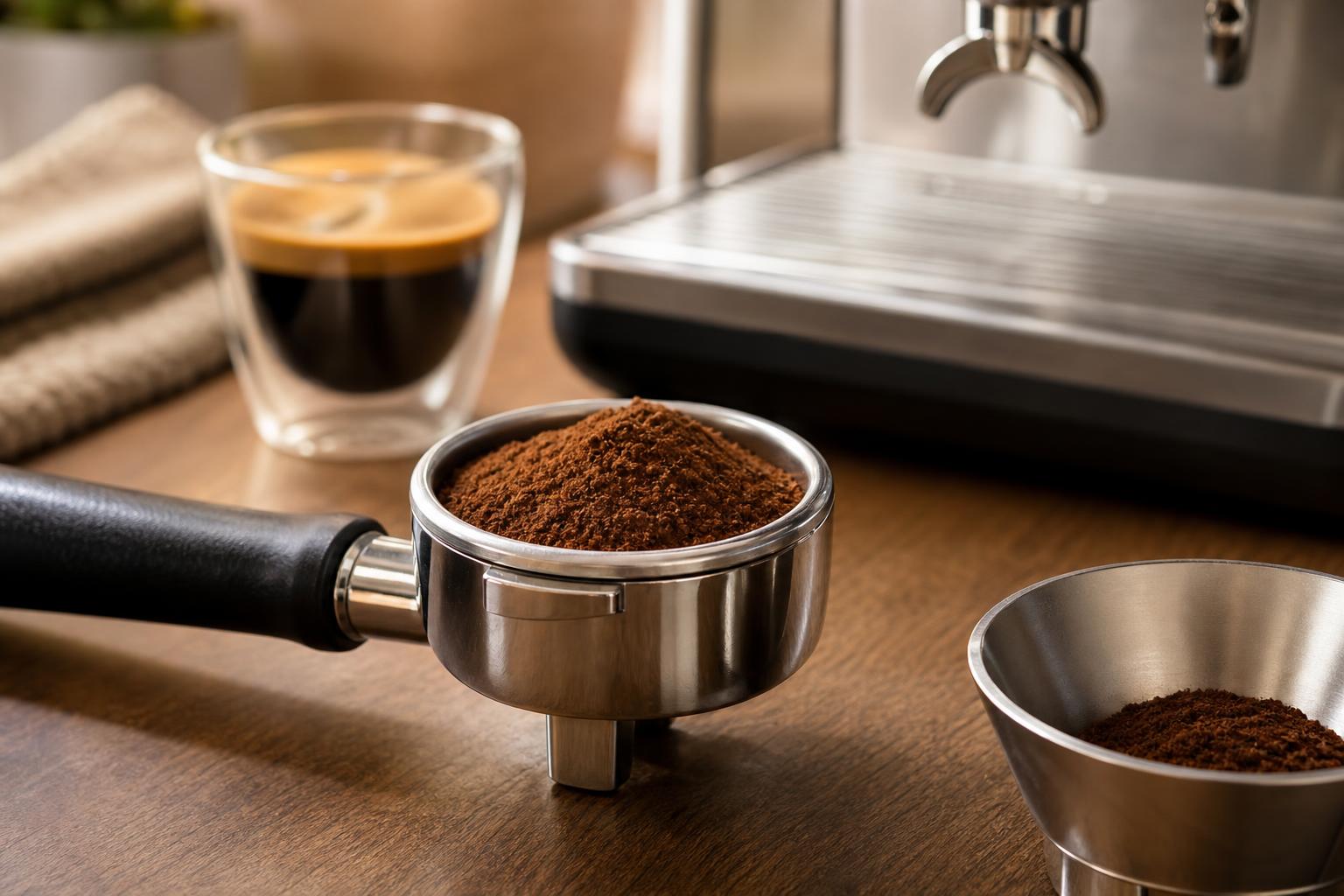
Learn how many grams of coffee to use for a double espresso, how basket size affects the dose, and how to adjust grind, yield and extraction.
How Much Coffee Goes in a Double Espresso?
Use 16–18 grams of ground coffee as a starting point for a double espresso, or match the dose to your basket capacity. An 18g basket usually works well with an 18g dose, but the best amount depends on your machine, coffee and preferred taste.
Explore the related selection here: How to Choose an Italian Coffee Gift Set.
Explore the related selection here: Why Is My Home Espresso Bitter? Causes and Fixes.
The standard coffee dose for a double espresso
A traditional double espresso commonly uses 14–18 grams of coffee. Larger modern baskets may be designed for 20–22 grams or more.
Useful starting ranges include:
- 14–16g: Smaller double baskets
- 16–18g: Common standard double baskets
- 18–20g: Many modern precision baskets
- 20–22g: Larger baskets and suitable equipment
“Double espresso” describes the basket and intended serving size, not a fixed coffee weight. Check the capacity marking on the basket whenever possible. A basket marked 18g is designed to hold approximately 18 grams of ground coffee.
The correct dose helps the puck fill the basket properly. Too little coffee can allow water to pass through too quickly or unevenly. Too much can cause the puck to press against the shower screen and restrict the flow.
How many grams of coffee go into a double shot?
If your machine has an 18g double basket, begin with 18 grams of coffee. Weigh the beans before grinding or weigh the ground coffee in the portafilter. A digital scale is more consistent than a spoon because grind size and bean density affect volume.
Your preferred dose may vary with the coffee. Light and dark roasts can require different extraction settings, while dense, fresh beans may occupy a different volume than older or darker beans at the same weight.
Consistency is the main goal. Using the same dose each time gives you a reliable reference when adjusting grind size, yield and extraction time.
Why the espresso basket matters
The basket determines how much coffee the portafilter is designed to hold. It also affects puck depth and the way water moves through the grounds.
Common basket capacities include:
- 14g
- 16g
- 18g
- 20g
- 22g
These figures are approximate but useful. The dose should leave enough space above the tamped puck for water to enter without the coffee pressing firmly against the shower screen.
Do not automatically use 18g in every basket. An 18g dose may be excessive in a 14g basket, while 14g may create a shallow puck in a 20g basket. Reassess the dose when changing machines, portafilters or baskets.
A simple double-espresso recipe
Use this recipe as a practical starting point:
- Dose 18g of freshly ground coffee.
- Use a fine grind suitable for espresso.
- Distribute the grounds evenly.
- Tamp level and consistently.
- Lock the portafilter into the group head.
- Aim for approximately 36g of liquid espresso.
- Start with an extraction time of roughly 25–30 seconds.
These numbers are guides rather than strict requirements. Taste is more important than matching a recipe perfectly.
If the espresso tastes sharp, thin or sour, the water may be flowing too quickly. If it tastes harsh, dry or very bitter, the shot may be flowing too slowly or extracting for too long. Adjust one variable at a time.
Explore the related selection here: Whole Bean or Ground Italian Coffee for Espresso?.
Coffee-to-water ratio and expected yield
A common starting ratio for espresso is 1:2. For every gram of dry coffee, aim for about two grams of liquid espresso.
Examples include:
- 16g in and approximately 32g out
- 18g in and approximately 36g out
- 20g in and approximately 40g out
The output is the weight of espresso in the cup, not the total amount of water dispensed by the machine. Some water remains in the coffee puck.
A shorter ratio, such as 1:1.5, can create a more concentrated drink. A longer ratio, such as 1:2.5, may suit some coffees that benefit from a larger yield. Use a scale under the cup to make recipes repeatable.
How grind size, tamping and freshness affect the result
Dose is only one part of espresso preparation. Grind size strongly affects flow rate.
If the grind is too coarse:
- Water may flow too quickly.
- The espresso may taste weak, sour or watery.
- The crema may disappear quickly.
If the grind is too fine:
- The flow may become very slow or stop.
- The coffee may taste bitter, dry or overly intense.
- The machine may struggle to produce a balanced shot.
Tamp the coffee into a level, compact surface. Consistent distribution and tamping matter more than using excessive force. Clumps or an uneven puck can cause channelling, where water takes narrow paths through the coffee.
Freshly ground coffee beans provide a better starting point. Store beans in an airtight container away from heat, light and moisture, and grind them immediately before brewing when possible. Freshness cannot correct an unsuitable dose or grind, but it supports a more consistent result.
Adjusting the dose to your machine and taste
Start by matching the dose to the basket. If it is marked 18g, try 18g and record the dose, yield and extraction time.
Consider adjusting the dose when:
- The puck sits too low or touches the shower screen.
- The espresso flows unevenly despite good distribution.
- The flavour remains too weak or intense at a suitable grind.
- You change the basket or portafilter.
- You want a smaller or larger drink.
Change one main variable at a time. Keep the dose at 18g while adjusting the grind if the shot runs too quickly. If the grind becomes impractically fine or coarse, then adjust the dose or yield.
The best dose is the one that fits the basket and produces the flavour you enjoy. Using 17g instead of 18g is perfectly reasonable if it suits your equipment and coffee.
Does a moka pot use the same amount of coffee?
No. A moka pot uses a different brewing method and should not be dosed like an espresso machine.
The funnel size determines the amount of coffee. Fill it with the intended quantity, level the grounds and do not tamp them down. A moka pot generally uses a grind finer than filter coffee but slightly coarser than traditional espresso. A very fine grind can restrict flow and produce a harsh taste.
Fill the water to just below the safety valve and use the funnel as designed. Unlike espresso, do not normally calculate the brew by stopping at a specific 1:2 ratio. Keep moka pot quantities separate from espresso dosing.
For Italian-style home coffee, choose a quality Italian coffee blend or beans suitable for moka preparation.
Common mistakes when measuring espresso coffee
Relying on scoops: A scoop measures volume, so the weight changes with grind size and bean density.
Ignoring basket capacity: A double basket is not automatically an 18g basket. Check its stated capacity.
Changing several variables: Altering dose, grind, tamp and yield together makes problems harder to diagnose.
Weighing only the beans: Grinder retention may mean less coffee reaches the basket. Weigh the grounds too when accuracy matters.
Distributing inconsistently: Clumps and uneven grounds can cause channelling even when the dose is correct.
Judging only by crema: Crema does not prove that an espresso is balanced. Taste, yield and repeatability are more useful measures.
Choosing coffee beans for a balanced double espresso
Choose beans according to your preferred flavour and how you plan to serve the coffee. Italian espresso blends often provide a familiar, full-bodied style, while single-origin coffees may have more distinctive fruit, floral or chocolate notes.
Consider these points:
- Choose beans labelled for espresso or recommended by the roaster.
- Buy an amount you can use while the coffee is still fresh and aromatic.
- Select a roast level that suits your taste and milk drinks, if applicable.
- Check whether the coffee is whole bean or pre-ground.
- Choose whole beans for greater control and grind them immediately before brewing.
Medium and medium-dark roasts can be approachable starting points, but lighter roasts can also work with suitable adjustments. Adapt the grind, yield and dose to the coffee rather than using one recipe for every bean.
A practical checklist for making a double espresso
- Confirm the basket capacity.
- Weigh the dose, starting with 16–18g for a typical double basket.
- Use freshly ground coffee.
- Set a grind suitable for espresso.
- Distribute the grounds evenly.
- Tamp level and consistently.
- Weigh the liquid espresso as it pours.
- Start with a 1:2 ratio, such as 18g in and 36g out.
- Use extraction time as a guide.
- Taste before making adjustments.
- Change one variable at a time.
- Clean the basket and group head after brewing.
In short, 18g is a sensible starting point for a double espresso in an 18g basket. The correct dose is the amount that suits your basket, coffee, machine and taste. Weigh the coffee, monitor the yield and make gradual adjustments.